- The Startupgenic
- Posts
- This Simple Habit App Quietly Makes $30K+ a Month
This Simple Habit App Quietly Makes $30K+ a Month
(~1 min 58 sec read) What happens when an app chooses simplicity over features, and wins.

Sweekar Koirala
December 26, 2025
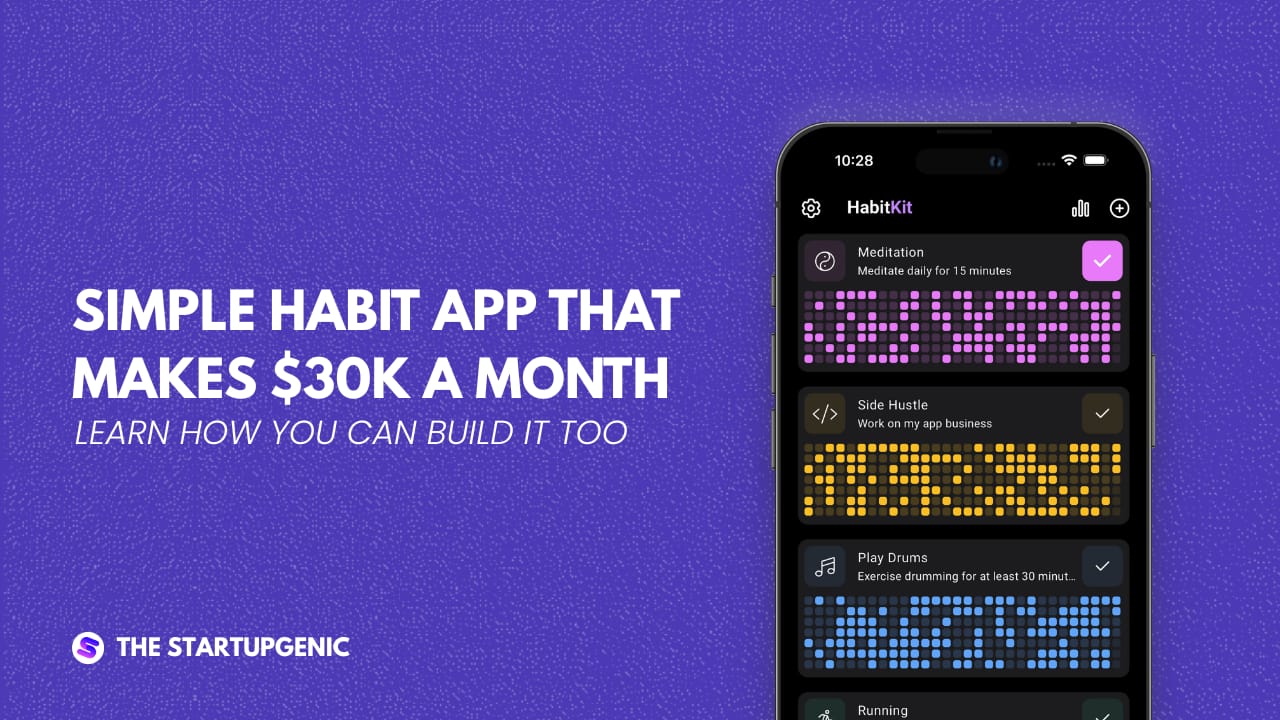
Most habit apps try to motivate you.
Most get deleted in a week.
HabitKit did the opposite. It stayed simple, calm, and boring, and built a real business.
The founder:
HabitKit was built by Sebastian Röhl, a software engineer from Germany.
Before HabitKit:
He worked a regular developer job
Quit to try building indie apps
Built his first app… and it failed badly
Barely got any downloads
Eventually went back to his job
That failure mattered. It taught him one thing very clearly:
Complexity doesn’t win. Clarity does.
The insight:
Sebastian used habit trackers himself and found them overcomplicated and guilt-driven.
He wanted one thing: a clear way to see progress.
So he built HabitKit for himself first.
The product:
What it does
Simple habit tracking
A clean grid that shows consistency at a glance
Reminders
Calendar history
Data stored locally, privacy-first
What it avoids
Social feeds
Gamified pressure
Forced accounts
Feature bloat
The grid became the product.
How it grew?
Early growth came from:
App Store search visibility. Sebastian did a really good App Store Search Optimization
Clear screenshots
Strong reviews
Word of mouth
One turning point was ranking high for key habit-related searches. That single distribution channel compounded over time.
This wasn’t viral growth.
It was quiet compounding.
Mistakes and trade-offs
His first app failed, completely
Growth was slow at the beginning
Revenue depended heavily on app store rankings
No aggressive expansion into social or enterprise features
But each trade-off protected focus.
Lessons for builders
Build for yourself first, but finish for others
Simplicity is a competitive advantage
Retention beats downloads
Organic distribution compounds quietly
A small app can be a real business
The real takeaway
HabitKit didn’t win because it was smarter.
It won because it was calmer.
In a market obsessed with doing more, it chose to do less, better.
And that’s why people keep them.
That’s it for this story.
Keep building.
See ya soon,
Sweekar Koirala
P.S.
New here? Check out thestartupgenic.com for more case studies, tools, and stories you won’t find on mainstream startup media.
Someone forwarded this mail? Subscribe here.